
The Unsung Hero: Exploring the Vital Role of the Central Defensive Midfielder (CDM) in Soccer
Table of Contents
Introduction
The Central Defensive Midfielder (CDM) is one of the most important positions in soccer. This position is responsible for providing a shield in front of the defense, breaking up opposing attacks and starting counter-attacks. As such, the role of the CDM is critical in providing the team with a secure defensive base from which to launch attacks.
In this article, we’ll explore the key traits and responsibilities of the Central Defensive Midfielder in soccer and how to excel in this critical position.
Central Defensive Midfielder (CDM) Role and Responsibilities

The primary role of the CDM is to provide a defensive shield in front of the defense. The CDM will often be the first player to break up any attacks from the opposition. They will be expected to stay in a defensive position and help to protect the back four from any danger. The CDM is also expected to be the first line of defense and to win the ball back whenever possible.
The CDM will also be asked to provide a link between the midfield and the defense. As such, the CDM needs to have good passing and vision, as well as the ability to play accurate short and long balls. The CDM will be responsible for providing the defense with the ball in the right areas, as well as helping the team to transition from defense to attack.
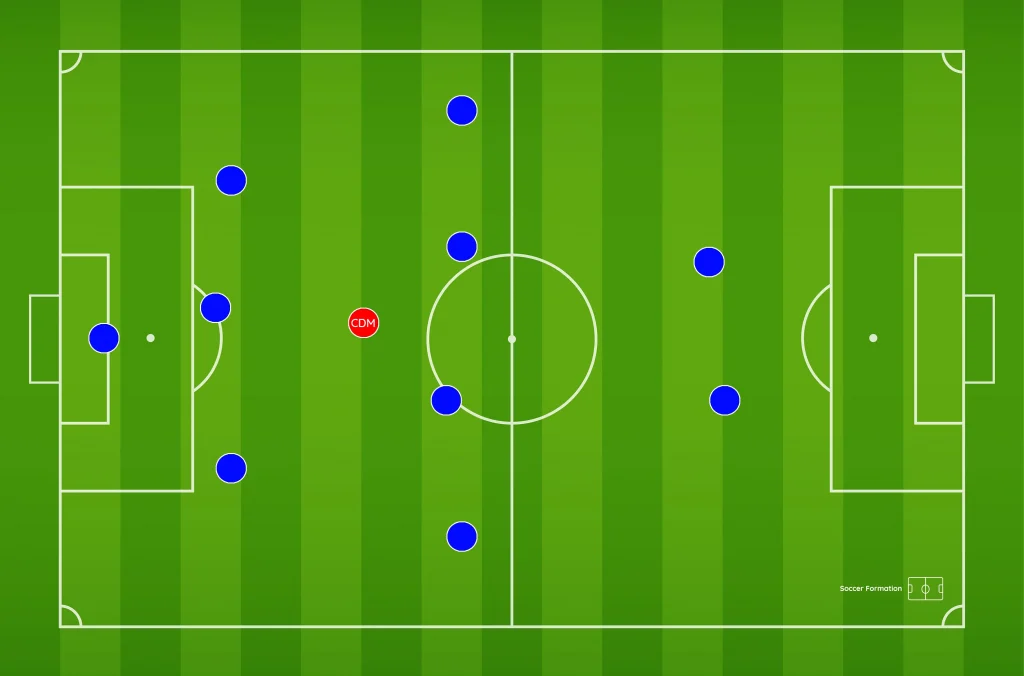
The CDM role requires a special combination of physical, technical, and tactical attributes. It is a position that requires immense concentration and discipline, and it is a position that can make or break a team’s defensive structure. As such, it is an extremely important position that requires a great amount of skill and knowledge.
Formations that Include a CDM
Here are some popular soccer formations that include a CDM:
- 4-2-3-1: This formation is a variation of the 4-4-2 formation, with two central midfielders playing behind an attacking midfielder. One of these central midfielders is often a CDM, whose primary role is to protect the backline and break up opposition attacks
- 4-3-3: Often used by teams that prioritize attacking play, with three central midfielders working together to control the midfield. One of these midfielders is often a CDM who sits deeper and helps protect the defense
- 3-5-2: Features three central defenders and two wing-backs, with a midfield triangle consisting of one CDM and two central midfielders. The CDM’s primary role is to protect the defense and provide a passing outlet for the center-backs
- 5-3-2: This is a defensive formation that includes five defenders, three central midfielders, and two strikers. The CDM in this formation is responsible for breaking up opposition attacks and protecting the defense
- 4-1-4-1: This is a versatile formation that includes a single CDM in front of a back four. The CDM’s primary role is to shield the defense and break up opposition attacks, while also providing support to the midfield.


Strengths of the Central Defensive Midfielder (CDM)
The CDM (Central Defensive Midfielder) role in soccer is a crucial position that requires a specific set of skills and attributes. Here are some key strengths that are typically associated with the CDM role:
- Tactical Awareness: The CDM is responsible for maintaining the balance between defense and attack. This requires a strong tactical understanding of the game, including positioning, marking, and anticipating the opposition’s movements
- Physical Strength and Stamina: The CDM must have excellent physical strength and stamina, as they are required to cover a lot of ground and engage in physical battles with the opposition
- Defensive Skills: The CDM must be an excellent defender, with the ability to make tackles, intercept passes, and win aerial duels
- Passing Ability: The CDM is often the link between defense and attack, and must be able to distribute the ball effectively to start attacks or relieve pressure, this should include both short and long-range passes
- Leadership: The CDM is often the heartbeat of the team, and must be a strong leader both on and off the pitch. They must communicate effectively with their teammates and provide direction and guidance
- Discipline: The CDM must be disciplined in their positioning and decision-making, as one mistake can lead to a goal-scoring opportunity for the opposition.
Overall, the CDM role is critical to the success of a team, and requires a unique combination of skills and attributes to be performed effectively.
Famous Central Defensive Midfielders
Some of the most prominent and highly rated central defensive midfielders in recent times include:
- Joshua Kimmich – Bayern Munich & Germany
- Sergio Busquets – Barcelona & Spain
- Casemiro – Manchester United & Brazil
- Fabinho – Manchester City & Brazil
- Rodri – Manchester City & Spain
- N’Golo Kante – Chelsea & France
- Jorginho – Arsenal & Brazil
- Sandro Tonali – AC Milan & Italy
Some of the greatest players to play in the CDM role include:
- Lothar Matthaus: Playing for clubs including Bayern Munich and Inter Milan as well as internationally for Germany
- Frank Rijkaard: Playing for clubs including Ajax and AC Milan as well as internationally for Netherlands
- Claude Makelele: Playing for clubs including Real Madrid and Chelsea as well as internationally for France
- Diego Simeone: Playing for clubs including Inter Milan and Atletico Madrid as well as internationally for Argentina
- Didier Deschamps: Playing for clubs including Marseille and Juventus as well as internationally for France
- Patrick Vieira: Playing for clubs including Arsenal and Inter Milan as well as internationally for France
- Roy Keane: Playing for clubs including Nottingham Forest and Manchester United as well as internationally for the Republic of Ireland
Each of these players possesses a unique set of skills and attributes that make them effective in their role, and their performances and achievements have earned them recognition and accolades in the sport.
Conclusion
In conclusion, the central defensive midfielder plays a crucial role in soccer, often serving as the engine that drives a team’s performance. While they may not always command the spotlight, their impact on a game is profound, dictating the rhythm of play, orchestrating attacks, and shoring up the defense. They represent the tactical core of a team, a pivotal link that seamlessly integrates defensive and offensive strategies.
Their work often goes unheralded, but the control and stability they offer in the heart of the field are invaluable. The role of the central defensive midfielder epitomizes the blend of skill, strategy, and subtlety that lies at the heart of soccer.
FAQs
These are just a few examples of soccer formations that include a CDM. The specific roles and responsibilities of the CDM may vary depending on the team’s tactics and style of play.
Central midfielders and defensive midfielders are two distinct positions in soccer, and while they share some similarities, there are also key differences between them.
Central midfielders typically play a more versatile role and are involved in both attacking and defensive aspects of the game. They are responsible for controlling the midfield, linking up with the forwards, and creating goal-scoring opportunities. They often have good passing and dribbling abilities and may score goals themselves. Examples of central midfielders include players like Kevin De Bruyne, Toni Kroos, and Luka Modric.
On the other hand, defensive midfielders, as the name suggests, have a more defensive role to play. They are responsible for shielding the backline, breaking up opposition attacks, and intercepting passes. They are often the first line of defense, and their primary focus is on stopping the opposition from scoring. They may also help initiate counter-attacks by distributing the ball quickly to the forwards. Examples of defensive midfielders include players like Sergio Busquets, Casemiro, and N’Golo Kante.
In summary, while both central midfielders and defensive midfielders operate in the central part of the pitch, their roles and responsibilities are different. Central midfielders are more involved in the attacking side of the game, while defensive midfielders have a more defensive role to play.
Some of the most prominent and highly-rated central defensive midfielders in recent times include Sergio Busquets, Casemiro, Fabinho, N’Golo Kante and Jorginho. Retired players include Lothar Matthaus, Frank Rijkaard, Claude Makelele and Roy Keane among others.
Ultimately, the choice of the best central defensive midfielder will depend on individual opinions and preferences.
The Importance of Versatile Players in Soccer
8 min read
Read about the importance of versatile players in soccer, highlighting their value and how they’re shaping the future of this global sport.