
Mid Block in Soccer
Table of Contents
Introduction
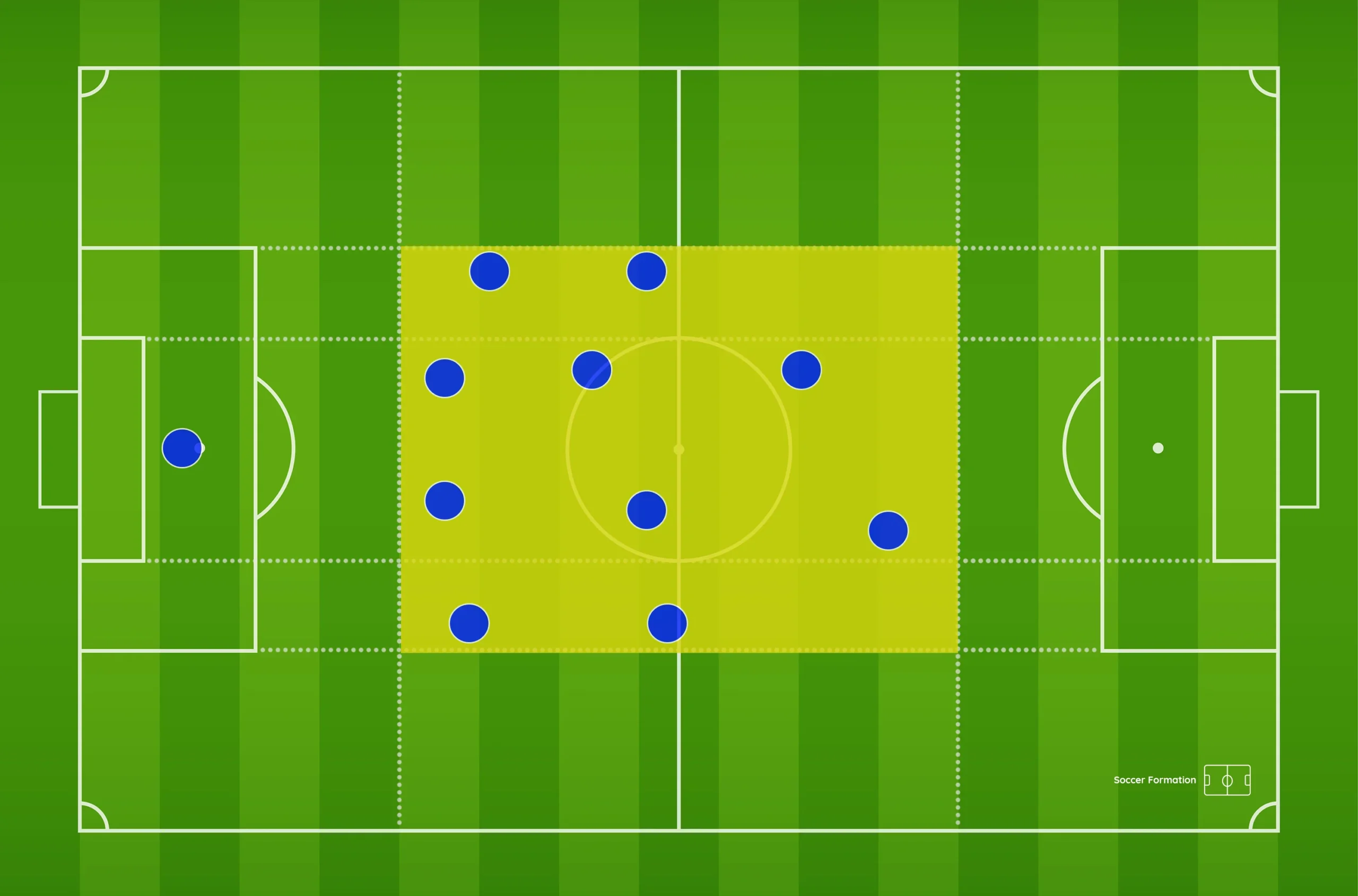
The mid block in soccer is a strategic defensive approach that occupies a middle ground between the high press and the low block. This tactic is employed by a team positioning itself not too deep in its own half, as in a low block, nor aggressively high up the pitch, as in a high press. Instead, the team sets up in a compact formation around the middle third of the field.
In this comprehensive guide, we’ll explain the mid block in more detail, explain some strengths and weaknesses as well as identify teams which have successfully implemented the strategy.
Key Characteristics of the Mid Block
Here’s a more detailed look at the mid block in soccer:
Spatial Control: In a mid block, the team aims to control the middle areas of the pitch. This reduces the space available for the opposition to play through the center, forcing them to use the wider areas of the field, which are generally less dangerous.

Compactness: Teams employing a mid block maintain a compact shape, with relatively little space between the lines of defense, midfield, and attack. This compactness makes it difficult for opponents to find space and pass through the team.

Balanced Approach: The mid block is considered a balanced strategy because it allows teams to be defensively stable without sacrificing too much attacking potential. Teams can transition more quickly to attack compared to a low block, as they are positioned higher up the pitch.
Pressing Triggers: While a mid block is less aggressive than a high press, teams will still apply pressure on the ball in certain situations, known as pressing triggers. These triggers might include a poor touch by an opponent, a backward pass, or the ball reaching a certain area of the pitch.
Reduced Risk: Employing a mid block reduces the risk of being caught out by long balls over the top or quick counter-attacks, which can be a vulnerability of teams that use a high press.
Flexibility: Teams using a mid block can adapt and transition between a low block and a high press depending on the game’s circumstances, making it a flexible tactical approach.
Player Communication: Communication and understanding among players are crucial. Players must know when to press and when to hold their positions, and they must work cohesively to maintain the team’s shape. The midfield plays a particularly vital role, as they must be adept at closing down spaces, intercepting passes, and initiating attacks once possession is regained.
Denying Space: Teams often use the mid block against opponents who are strong in possession or have a potent attacking threat. By denying space in the middle of the park, the defending team can disrupt the opposition’s rhythm and create opportunities to win the ball in advantageous positions.
Strengths of the Mid Block
Here are some of the key strengths of employing a mid block:
- Defensive Stability: By setting up in the middle third, teams can effectively close down spaces and passing lanes. This compactness makes it harder for opponents to play through the center, forcing them to opt for less threatening wide areas or long-range efforts.
- Control of Key Areas: The mid block allows teams to exert control over crucial areas of the pitch, particularly the midfield. Dominating the midfield can disrupt the opposition’s build-up play and limit their ability to create goal-scoring opportunities.
- Flexibility and Adaptability: One of the main strengths of the mid block is its flexibility. Teams can adjust their approach based on the flow of the game, transitioning to a high press or dropping into a low block as the situation demands.
- Balanced Offensive and Defensive Approach: Unlike a high press that may leave teams vulnerable to counter-attacks, or a low block that limits attacking options, the mid block offers a balance. It provides a stable defensive setup while still maintaining a threatening posture for quick transitions and counter-attacks.
- Energy Efficiency: The mid block is less physically demanding than a constant high press, allowing players to conserve energy. This efficiency can be crucial, especially in games where maintaining intensity for the full 90 minutes is challenging.
- Pressing Triggers: While the mid block is less aggressive than a high press, it still allows teams to apply pressure on the opposition in specific scenarios. These pressing triggers can lead to winning possession in advantageous areas, creating opportunities to attack a disorganized defense.
- Reduced Risk of Being Overrun: By not committing too many players forward as in a high press, or too many players deep as in a low block, the mid block reduces the risk of being overrun in both defensive and offensive transitions.
- Suitability Against Various Opponents: The mid block is effective against a wide range of opponents, whether they are possession-based teams or those that rely on quick transitions. It provides a strategic middle ground that can be tweaked to handle different styles of play.
- Easier Implementation: Compared to the high press or low block, which require very specific player attributes and rigorous training to execute effectively, the mid block can be easier for teams to implement and adapt to, making it a versatile choice for many coaches.
Weaknesses of the Mid Block
Here are some of the key weaknesses associated with the mid block:
- Vulnerability to Skilled Playmakers: Teams employing a mid block can be vulnerable to opponents with highly skilled playmakers who can unlock defenses with precise passing. These players can find pockets of space within or around the mid block, especially if the defending team’s concentration or discipline lapses.
- Space on the Flanks: By focusing on controlling the central areas of the pitch, the mid block can sometimes concede space on the flanks. This can be exploited by teams with strong wingers or full-backs who are effective in wide areas, leading to crosses into the box or cut-backs that create scoring opportunities.
- Less Aggressive Pressing: Since the mid block is not as aggressive as a high press, it may allow technically proficient teams more time on the ball to build up play from the back. This can be particularly challenging if the opposition excels in maintaining possession and patiently probing for openings.
- Transition Vulnerabilities: While the mid block aims to balance defense and attack, there can be moments of vulnerability during transitions, especially if the team loses possession in the midfield. Quick counter-attacks by the opposition can catch the team off guard, particularly if the midfielders and defenders are not perfectly synchronized.
- Requires Disciplined Positioning: Maintaining an effective mid block requires disciplined positioning and spatial awareness from all players. Any breakdown in this discipline, such as players not maintaining the compact shape or failing to track back, can lead to gaps that the opposition can exploit.
- Potential for Reduced Offensive Threat: While the mid block is more offensively oriented than a low block, it can sometimes lead to a reduced attacking threat compared to a high press, especially if the team struggles to transition quickly from defense to attack.
- Difficulty Against Deep-Lying Teams: Teams that sit deep and are content with a draw or protecting a lead can be difficult to break down with a mid block. In such cases, a more aggressive approach like a high press might be necessary to force turnovers and create scoring opportunities.
- Mental and Physical Demands: While less exhausting than a high press, the mid block still requires significant mental concentration and physical effort to maintain shape, track movements, and execute quick transitions. Over the course of a match, lapses in concentration or fatigue can lead to mistakes.
How to Beat a Mid Block
Here are several strategies and tactics that can be effective in breaking down a mid block:
- Quick, Precise Passing: Rapid and accurate passing can disrupt the shape of the mid block. Short, quick passes can draw defenders out of position, creating gaps in their formation. This approach requires high technical skill and good coordination among players.
- Utilize Width: Expanding the game to the wider areas of the pitch can stretch the mid block. Using wingers and full-backs to create width and deliver crosses can be effective. Overlapping runs and wide combinations can pull the compact defense apart, creating space in central areas.
- Switching Play: Long diagonal passes to quickly change the point of attack can catch a mid block off balance. Regularly switching play forces the defending team to adjust their positions constantly, which can lead to openings.
- Vertical Runs and Through Balls: Encouraging forwards or attacking midfielders to make vertical runs behind the midfield line can disrupt the defensive structure. Through balls that exploit these runs can create direct goal-scoring opportunities.
- Patient Build-Up Play: Maintaining possession and building up play patiently can draw the mid block out and create spaces. This approach requires players to be comfortable under pressure and adept at maintaining possession.
- Overloading Midfield: Adding an extra player or two in the midfield can help outnumber and outmaneuver the opposition in central areas. This can lead to better control and more opportunities to penetrate the defense.
- Effective Use of Set-Pieces: Set-pieces (corners, free-kicks) can be crucial, especially when open play is tightly contested. Well-rehearsed routines can exploit potential vulnerabilities in the mid block setup.
- High Pressing: Applying high pressure when out of possession can force errors in the opposition’s build-up. Winning the ball high up the pitch can lead to scoring opportunities before the mid block is fully organized.
- Dynamic Movement Off the Ball: Encouraging players to make dynamic runs off the ball, including overlapping, diagonal runs, and dropping deep to receive the ball, can create confusion in the defensive structure.
- Shooting from Distance: If space around the penalty area is limited, players capable of shooting from distance can be valuable. Long-range shots can lead to goals or result in rebounds and secondary chances.
- Targeting Weak Links: Identifying and exploiting weaker players in the opposition’s setup can be effective. Isolating certain defenders in one-on-one situations or overloading their zone can create scoring opportunities.

What Teams Use a Mid Block?
Here are some examples of teams that have utilized a mid block in their tactical setups:
- Atlético Madrid under Diego Simeone: Simeone’s Atlético Madrid has often been recognized for its disciplined defensive approach. While they are capable of deploying a deep block, they have also effectively used a mid block, especially in matches where they aim to exert more control in the midfield without overextending themselves.
- Chelsea under Thomas Tuchel: Tuchel’s Chelsea, particularly in his earlier tenure, showed versatility in their defensive setups, including the use of a mid block. This approach allowed them to maintain defensive solidity while also being prepared to exploit counter-attacking opportunities.
- Tottenham Hotspur under José Mourinho: Mourinho’s teams are traditionally known for their strategic defensive approaches. During his time at Tottenham, Mourinho often employed a mid block, especially in games against offensively strong teams, to balance between defense and attack.
- Inter Milan under Antonio Conte: Conte’s Inter Milan, especially during their Serie A title-winning season, occasionally used a mid block as part of their versatile defensive strategies. This approach was particularly evident in matches where they faced opponents with strong midfield presence.
- Borussia Dortmund under Lucien Favre: Favre’s Dortmund was known for its flexibility in tactical approaches, including the use of a mid block in certain games. This allowed them to control the midfield area while still posing a threat on the counter-attack.
- Leicester City under Brendan Rodgers: Rodgers’ Leicester City has shown the ability to adapt their defensive tactics based on the opposition. They have employed a mid block in various games, using it to disrupt the opposition’s play in the midfield and transition quickly into attack.
It’s important to note that the use of a mid block is often situational and can vary from game to game. Coaches may decide to implement this strategy based on the specific strengths and weaknesses of their own team as well as those of their opponents. Additionally, the tactical landscape in soccer is always evolving, with teams and coaches continually adapting and refining their strategies.
Conclusion
The mid block is a versatile and balanced defensive strategy, offering a blend of defensive security and offensive potential.
A successful mid block in soccer hinges on several key elements. These include team shape, player discipline, communication, spatial awareness, and the ability to transition quickly.
In summary, the mid block in soccer is a tactical approach that offers a balance between defensive solidity and attacking opportunity. It requires disciplined positioning, good communication, and the ability to quickly transition between defense and attack. This strategy is favored by teams looking to exert control in the midfield while remaining prepared for both defensive and offensive phases of the game.
FAQs
Training for mid block involves a focus on tactical understanding, positioning, and teamwork. Drills are designed to improve players’ awareness of space and their roles within the team structure. Exercises that simulate match scenarios help players practice maintaining shape, pressing as a unit, and transitioning from defense to attack. Coaches often use video analysis to review and refine the team’s mid block tactics.
Implementing mid block in soccer presents several challenges. It requires a high level of tactical discipline and understanding from all players. Maintaining the right balance between defense and attack can be difficult, as overcommitting in either direction can lead to vulnerabilities. Additionally, mid block demands physical fitness and mental alertness, as players must be ready to switch from defense to attack rapidly.
Low Block in Soccer
8 min read
In this comprehensive guide, we’ll explain the low block in more detail, explain some strengths and weaknesses as well as identify teams which have successfully implemented the strategy.