3-4-3 Soccer Formation
The Definitive Guide
This is the complete guide to the 3-4-3 soccer formation.
In this guide, you’ll learn:
- 3-4-3 formation setup
- 3-4-3 formation strengths
- 3-4-3 formation weaknesses
- Lots more
Read on to find out more.
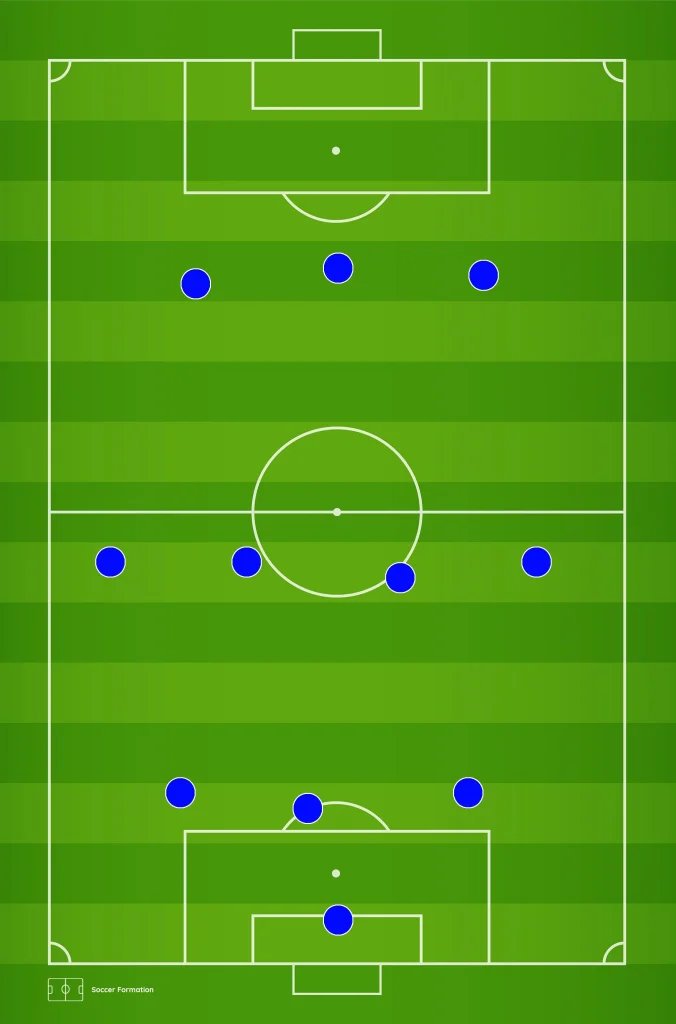
3-4-3 Formation Setup
The 3-4-3 soccer formation has become increasingly popular in modern football, thanks to its attacking potency and flexibility. This formation relies on three forwards to provide a constant threat in the opposition half, while also offering a solid defensive base with three center-backs. With two central midfielders and wide midfielders (or wing-backs if a formation variation is used) providing width and support in attack, the formation can be adapted to suit different styles of play, making it a versatile option for coaches and teams.
The 3-4-3 soccer formation is a tactical setup that uses three central defenders, four midfielders, and three forwards to create a well-balanced team that can both defend and attack effectively. The formation typically consists of three center-backs, two central midfielders, two wide midfielders, and a front three of two wingers (or inside forwards) and a central striker.

The three defenders provide a solid defensive base and cover for the goalkeeper, while the midfielders provide the link between defense and attack. The two wing-backs offer width and support in attack, while also providing cover in defense. The three forwards create a constant attacking threat and are responsible for scoring goals.
The formation can be adapted to suit different styles of play, with the wing-backs able to drop back into defense when necessary. With its focus on quick transitions and fluid movement, the 3-4-3 formation has become a popular option among coaches and teams looking to dominate on the field.
3-4-3 Formation Variations
Here are some variations of the 3-4-3 soccer formation:
With Wing-Backs

The inclusion of wing-backs in this setup provides a crucial link between defense and attack, enabling teams to exploit spaces, create overloads, and maintain balance throughout the pitch.
The deployment of wing-backs can revolutionize a team’s tactical approach and contribute to their success on the field.
With Diamond Midfield

This variation aims to create a harmonious balance between defensive solidity, midfield control, and attacking threat, by marrying the stability of a three-man backline with the versatility of a diamond-shaped midfield and a dynamic trio of forwards.
The diamond midfield offers a distinct advantage by allowing teams to dominate the central areas of the pitch, providing both defensive cover and ample creative outlets for penetrating opposition defenses.
3-4-3 Formation Strengths
The 3-4-3 soccer formation has several strengths if implemented correctly, including:
- Attacking potency: With three forwards, the formation is designed to provide plenty of attacking options, making it difficult for the opposition to defend against. The formation can create multiple passing options in the final third, which can lead to more scoring opportunities
- Possession-based play: The formation can be used to dominate possession, as the two central midfielders provide a solid base for retaining the ball, while the wider midfielders or wing-backs provide width and support in attack
- Defensive stability: With three center-backs, the formation offers a solid defensive base, making it difficult for the opposition to penetrate through the middle. The wing-backs can also track back to provide extra defensive cover
- Flexibility: The formation can be adapted to suit different styles of play, as the midfield and attacking players can be adjusted to provide more defensive cover or attacking flair as needed
- Counter-attacking: The formation can be very effective on the counter-attack, with the three forwards capable of quickly transitioning from defense to attack, and the wing-backs providing support on the flanks.
3-4-3 Formation Weaknesses
The 3-4-3 soccer formation also has some weaknesses that should be considered:
- Vulnerable to counter-attacks: The formation can leave the team vulnerable to counter-attacks, especially if the wing-backs are caught up the field and unable to track back in time to defend
- Defensive imbalances: While the formation provides a solid defensive base with three center-backs, it can also create defensive imbalances if the midfielders fail to provide enough cover in front of the defense
- Lack of midfield control: The formation can struggle to control the midfield, especially against teams that play with more players in the center of the park. This can lead to a lack of possession and a struggle to create scoring opportunities
- Over-reliance on the forwards: With three forwards, the formation can sometimes be over-reliant on the attacking players to create goals, leaving the team exposed if they fail to score
- Limited width: While the wing-backs provide width, the formation can sometimes lack natural wingers, which can limit the team’s options for crossing and attacking down the flanks.
3-4-3 Versus Other Formations
Let’s see how the 3-4-3 formation matches up against other popular formations:
3-4-3 Versus 4-4-2

3-4-3 Versus 4-4-3

3-4-3 Versus 4-2-3-1

3-4-3 Versus 4-2-2-2

3-4-3 Versus 3-5-2

Conclusion
The 3-4-3 soccer formation is an attractive option for soccer coaches who seek to exploit the potential of their players and adopt a proactive, attack-minded approach. The formation’s flexibility, balance, and adaptability make it ideal for teams with strong attacking prowess, versatile midfielders, and intelligent defenders. The 3-4-3 system allows teams to dominate possession, create overloads in various areas of the pitch, and transition quickly between defense and attack. Moreover, its fluidity encourages players to interchange positions, fostering creativity and unpredictability, which can pose significant challenges for the opposition.
However, it is essential for coaches to consider their team’s individual strengths and weaknesses when implementing the formation. Adequate preparation, tactical awareness, and effective communication among players are vital components in successfully deploying this system. Coaches should also be prepared to make adjustments and modifications based on the specific demands of each match.
Ultimately, the 3-4-3 soccer formation can be a valuable strategic tool that, when executed well, can elevate a team’s performance and help them achieve their objectives on the field.
FAQs
Here are some FAQs related to the 3-4-3 soccer formation:
The 3-4-3 formation can be a good formation when implemented correctly by a team. It allows for a well-balanced team that is able to both defend and attack effectively. The three defenders provide a solid defensive base, while the four midfielders can help in both defense and attack. The three forwards create a constant attacking threat and are responsible for scoring goals. However, like any formation, it also has its weaknesses and can be susceptible to counter-attacks if the team loses possession of the ball in the midfield. Ultimately, whether the formation is a good option for a team depends on the team’s strengths, weaknesses, and the style of play they want to implement.
There is no one formation that is guaranteed to beat a 3-4-3 formation, as it ultimately depends on various factors such as the strengths and weaknesses of each team, their tactics, and the style of play. However, some formations that can be effective against a 3-4-3 include a 4-2-3-1 or a 5-3-2. A 4-2-3-1 formation can provide extra cover in midfield, preventing the 3-4-3 team from dominating possession and attacking effectively. The two defensive midfielders can also mark the three forwards and limit their attacking threat. Similarly, a 5-3-2 formation can provide extra cover in defense, with the three center-backs able to mark the three forwards effectively. The wing-backs can also provide width and support in attack, while also tracking back to help in defense. Ultimately, the success of any formation against a 3-4-3 depends on how well the team executes its tactics and strategy on the field.
The 3-4-3 formation requires players who are versatile, technically proficient and possess high levels of fitness.
The three forwards in the formation are typically quick, skillful, and capable of scoring goals. They should also be comfortable dropping deep to receive the ball and linking up with midfielders.
The four midfielders in the formation require a combination of defensive and attacking skills. The central midfielders should be strong, aggressive, and able to cover ground quickly. They should also be comfortable playing both short and long passes. The wide midfielders need to be able to provide width in attack while also tracking back to help in defense.
The three center-backs in the formation should be strong, dominant in the air, and comfortable with the ball at their feet. They should also be capable of playing accurate long balls to the forwards or midfielders.