
The Critical Role of Center-Back in Soccer: Mastering the Position
Table of Contents
Introduction
The center-back is a crucial player in the game of soccer, responsible for anchoring the defense and preventing the opposing team from scoring. As the last line of defense, the center-back must possess a combination of physical and mental attributes to effectively protect their team’s goal.
In this article, we will explore the role of the center-back in soccer, including their key responsibilities, common strengths and weaknesses, and some of the best players to have ever played the position.
Center-Back Role and Responsibilities

Center-backs hold one of the most critical positions on the field, often being the last line of defense before the goalkeeper. The center-back is primarily tasked with blocking the opposition’s forward players, intercepting passes, and winning headers during both open play and set pieces.
A center-back needs a distinctive combination of physical strength, aerial prowess, positional awareness, and tackling ability. Furthermore, they often require excellent communication skills to organize the defense and maintain the team’s defensive shape.
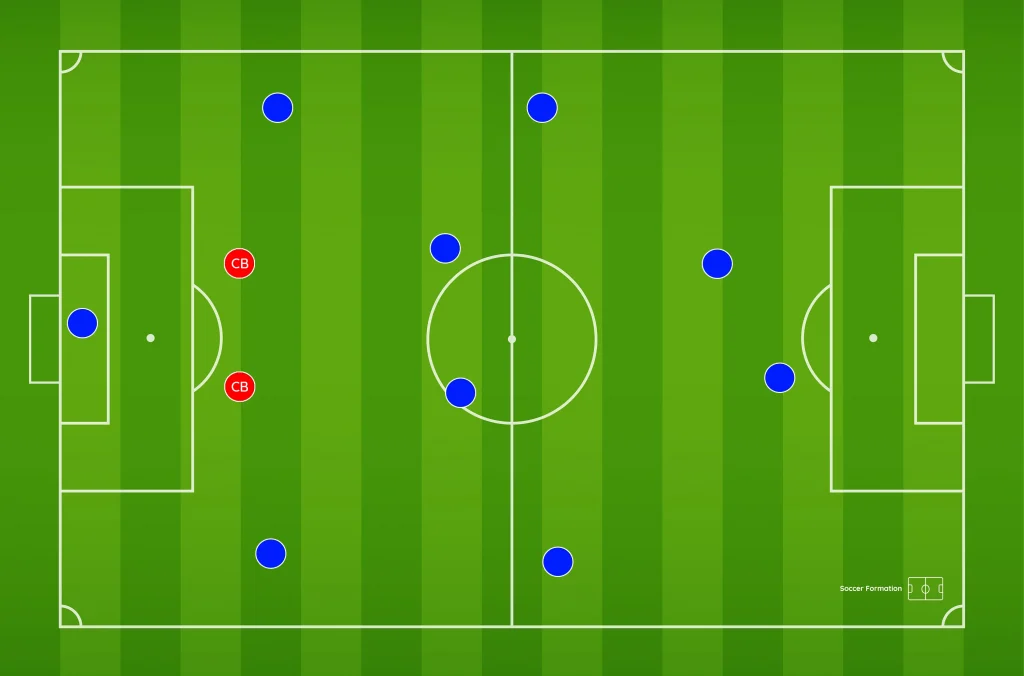
In modern soccer, the role of the center-back has evolved to include aspects of ball distribution and initiating attacks from the back, thus requiring additional technical skills.
Formations that Include Center-Backs
All soccer formations include at least one center-back. Formations can be split as follows:
- Those with two center-backs, such as the 4-4-2, 4-3-3 and 4-2-3-1 formations
- Those with three center-backs, such as the 3-5-2 and 3-4-3 formations

Strengths of the Center-Back
Here are some of the key strengths of the center-back in soccer:
- Defensive prowess: The center-back is primarily responsible for stopping opposing attacks and defending their team’s goal. They are skilled at marking and intercepting the opposition’s passes and are excellent at tackling
- Leadership qualities: Center-backs are often seen as the backbone of the team’s defense and as such are expected to be leaders on the field. They must possess strong leadership qualities to motivate their teammates and inspire them to perform at their best
- Strong physical presence: Center-backs are often tall and muscular, which gives them an advantage in aerial duels and helps them win the ball back from opposing players
- Good communication skills: The center-back is often the leader of the defense, and they must have excellent communication skills to coordinate their teammates and ensure that everyone is in the right position
- Ability to read the game: A good center-back can read the game and anticipate the movements of opposing attackers, which allows them to make interceptions and break up attacks before they become dangerous
- Ball-playing skills: In modern soccer, center-backs are expected to be comfortable on the ball and able to start attacks from the back. They are often tasked with playing long passes to start counter-attacks or dribbling past opposing players to create space
- Versatility: Although center-backs are primarily defensive players, they also have the ability to play in other positions on the field, such as defensive midfield or even fullback. This versatility can be an asset to a team, as it allows them to adapt to different game situations
- Set-piece prowess: Center-backs are often the targets for set-piece plays, such as corners or free kicks. With their height and physicality, they can be dangerous in the opposing team’s penalty box, both in defending their own goal and attacking the opponent’s
- Mental toughness: A good center-back must have the mental toughness to withstand pressure and maintain their concentration throughout the game. They must be able to handle high-pressure situations and make split-second decisions
- Experience: Center-backs often have years of experience under their belts, which gives them a strategic advantage over younger or less-experienced players. Their experience helps them make better decisions on the field and anticipate the opposition’s tactics.
Weaknesses of the Center-Back
While the center-back is a crucial position in soccer, they also have some potential weaknesses that can be exploited by the opposing team. Here are some of the weaknesses of the center-back in soccer:
- Lack of pace: Center-backs are often not as fast as other players on the field, which can leave them vulnerable to quick counter-attacks or through balls played behind the defense
- Poor decision-making: In high-pressure situations, center-backs can sometimes make poor decisions, such as making a mistimed tackle or committing a foul that leads to a penalty
- Over-reliance on physicality: While a center-back’s physicality can be an asset, relying too much on it can also be a weakness. If a center-back becomes too aggressive in their tackles or marking, they can give away unnecessary fouls and receive yellow or red cards
- Lack of creativity: While center-backs are expected to be strong defenders, they are not always the most creative players on the field. They may struggle to make incisive passes or break through opposition lines
- Poor communication: As the leader of the defense, the center-back must have strong communication skills to coordinate with their teammates. If they struggle to communicate effectively, it can lead to confusion and errors in the defense
- Difficulty with agile attackers: Center-backs can sometimes struggle to defend against agile attackers who are able to change direction quickly or use their dribbling skills to get past defenders
- Height limitations: While height can be an asset for center-backs, particularly in aerial duels, they can sometimes struggle against shorter, more agile attackers who are able to get past them on the ground
- Vulnerability on the flanks: When playing in a four-man defense, the center-backs are often responsible for covering the gaps left by the fullbacks when they move up the field. This can leave them vulnerable to attacks from the opposition’s wingers, who can exploit the space on the flanks
- Mental fragility: Center-backs can sometimes struggle to cope with the pressure of defending their team’s goal. If they make a mistake or give away a goal, it can have a negative impact on their confidence and mental state, which can in turn affect their performance
- Lack of versatility: While some center-backs are able to play in other positions, such as defensive midfield or fullback, others may struggle to adapt to different roles on the field. This lack of versatility can limit their usefulness to the team in certain situations.
Famous Center-Back’s
There have been many great center-backs in the history of soccer, and opinions on who the best are may vary depending on factors such as era, playing style, and personal preference. Here are a few names that are often considered to be among the best center-backs in soccer:
- Franco Baresi: The Italian defender is widely regarded as one of the greatest center-backs of all time. He spent his entire career at AC Milan, where he won six Serie A titles and three European Cups
- Franz Beckenbauer: The German defender, nicknamed “Der Kaiser”, was a dominant force in the 1970s. He won the World Cup as both a player and a manager, and is credited with popularizing the attacking sweeper role
- Paolo Maldini: Another Italian legend, Maldini spent his entire career at AC Milan, where he won seven Serie A titles and five European Cups. He was known for his impeccable defensive skills and leadership qualities
- Sergio Ramos: The Spanish defender has been a key player for Real Madrid and the Spanish national team for many years. He is known for his tough tackling, aerial ability, and leadership on the field
- Virgil van Dijk: The Dutch defender has been a standout player for Liverpool since joining the club in 2018. He is known for his physicality, aerial ability, and ability to read the game
- Fabio Cannavaro: The Italian defender won the World Cup with Italy in 2006 and was named the tournament’s best player. He also won two Serie A titles and a Champions League title with Juventus
- Carles Puyol: The Spanish defender spent his entire career at Barcelona, where he won six La Liga titles and three Champions League titles. He was known for his tough tackling and leadership qualities
- Rio Ferdinand: The English defender was a key player for Manchester United for many years, winning six Premier League titles and a Champions League title with the club. He was known for his composed defending and excellent distribution
- Thiago Silva: The Brazilian defender has played for some of the top clubs in Europe, including AC Milan, Paris Saint-Germain, and Chelsea. He is known for his technical ability, leadership, and aerial prowess
- Gerard Pique: The Spanish defender has been a stalwart in the Barcelona defense for many years, winning numerous domestic and international titles with the club. He is known for his excellent positioning and ability to read the game.
Conclusion
The center-back position in soccer is a cornerstone of any team’s defensive strategy. Their primary duty to thwart the opposition’s attacking attempts is crucial to preserving the integrity of a team’s goal. Beyond their defensive duties, modern center-backs are increasingly involved in initiating attacks, underscoring their evolving role in the game.
While they may not frequently find themselves in the limelight of goal scorers, the importance of their role cannot be overstated. A strong performance from a center-back can drastically minimize the threats to a team’s goal, often dictating the level of pressure the team faces.
Ultimately, the center-back’s blend of defensive resilience, positional awareness, and ever-growing contribution to the offensive build-up plays an indispensable role in the complex and enthralling world of soccer.
FAQs
It’s difficult to definitively say who the best center-back in the world is, as opinions may vary depending on a number of factors such as playing style, team success, and personal preference. However, there are a few players who are often mentioned in discussions about the top center-backs in the world. These include:
Virgil van Dijk – Liverpool & Holland
Marquinhos – PSG & Brazil
Eder Militao – Real Madrid & Brazil
Kim Min-Jae – Napoli & South Korea
David Alaba – Real Madrid & Austria
Ruben Dias – Manchester City & Portugal
Milan Skriniar – Inter Milan & Slovakia
Ultimately, determining the best center-back in the world is subjective and can depend on a variety of factors.
There are several English center-backs who are widely considered to be among the best in the world, including Harry Maguire, John Stones, and Joe Gomez. However, it’s difficult to definitively say who the best English center-back is as opinions may vary depending on a number of factors such as playing style, team success, and personal preference. Ultimately, the title of the best English center-back is subjective and can depend on individual opinions.
Yes, a center-back can be short. While height is often seen as an advantage for center-backs due to their defensive responsibilities in the air, there are many successful center-backs who are shorter than the average player at their position. In fact, a shorter center-back may have certain advantages such as greater speed, agility, and ability to read the game, which can be valuable assets in certain defensive situations. However, it’s important to note that height can still be an advantage for center-backs, particularly when defending against crosses and set pieces. Some short center-backs include:
Franco Baresi (5’9″/175cm)
Javier Mascherano (5’9″/175cm)
Fabio Cannavaro (5’9″/175cm)
Lisandro Martínez (5’9″/175cm)
The Importance of Versatile Players in Soccer
8 min read
Read about the importance of versatile players in soccer, highlighting their value and how they’re shaping the future of this global sport.