4-3-3 Soccer Formation
The Definitive Guide
This is the complete guide to the 4-3-3 soccer formation.
In this guide, you’ll learn:
- 4-3-3 formation setup
- 4-3-3 formation strengths
- 4-3-3 formation weaknesses
- Lots more
Read on to find out more.
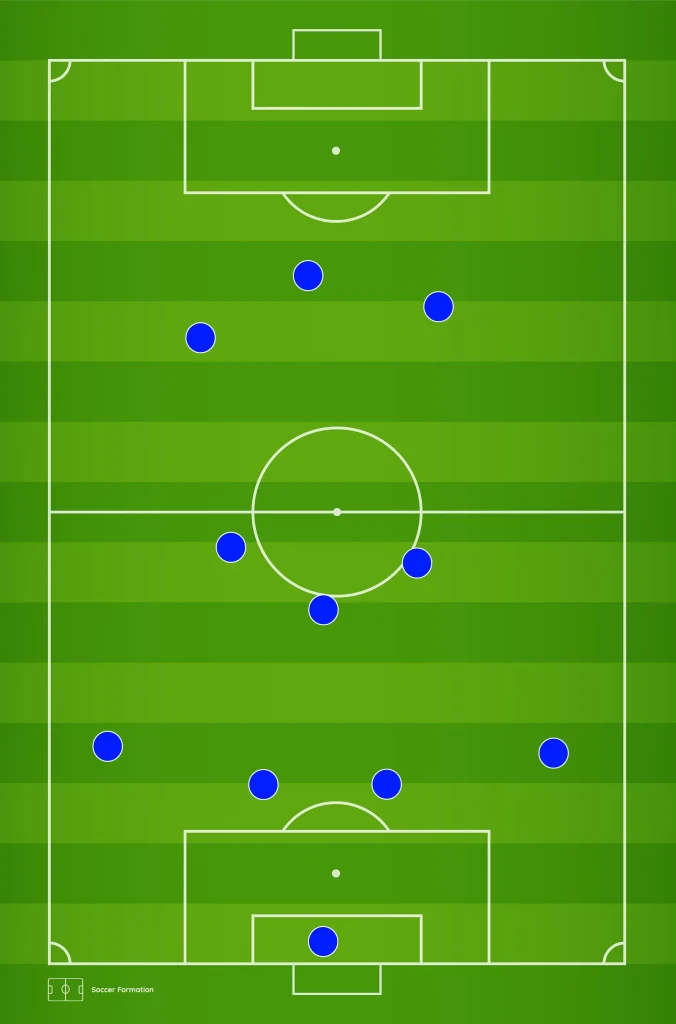
4-3-3 Formation Setup
The 4-3-3 formation is made up of a goalkeeper, four defenders, three midfielders, and three forwards. The defenders form a line of four across the back, with the two outside defenders (fullbacks) providing width and the two central defenders providing protection in the middle. The defenders are responsible for providing the team with a solid defensive base, cutting out opposition attacks before they can reach the goal. The fullbacks are then responsible for providing width in the defense, allowing the team to stretch the opposition across the pitch.

The midfielders form a line of three across the middle of the field, with the center midfielder usually playing a defensive role while the two outside midfielders provide width and support the attack.
The forwards form a line of three across the front, with one forward playing an attacking role while the other two provide support and width. These forwards are usually a combination of a target man, who can hold the ball up and bring others into play, and more pacey and mobile players who can stretch the opposition defense and get in behind. Sometimes, a false nine is used to bolster the midfield, acting as a pivot between the midfield and attack, creating space for the wide players to exploit.
4-3-3 Formation Strengths
- Attacking Options: Strong attacking presence with three forwards who can create scoring opportunities
- Pressing from the Front: Can be effective in pressing and counter-attacking situations with the pace and skill of the forwards and midfielders. Provides the option for a high press
- Formation Variation: Allows for versatile tactical adjustments and formation changes depending on the game situation and opponent, such as a 4-5-1 or 4-4-2. Ideal for the use of a false nine
- Midfield Control: Allows for good ball possession and control in the midfield, making it difficult for the opposition to get the ball
- Solid Defense: Defensive solidity with the back four, allowing for protection against counter-attacks
- Formation Balance: Strong and balanced attack with the forwards and midfielders working together to create scoring opportunities
- Flexibility and Versatility in the Formation: Players able to switch positions and adapt to different situations. Provides a good mix of attacking and defensive capabilities, making it a well-rounded and effective formation. Offers flexibility in midfield with three central midfielders who can play various roles, including holding, attacking, and creative play
- Playing Style: Provides the option to play a more possession-based game with the extra midfield player (especially against an opposition midfield two)
4-3-3 Formation Weaknesses
- Lack of Attacking Options on the Wings: Relies heavily on the fullbacks to provide width and attacking support, which can leave the team vulnerable if the fullbacks are unable to get forward effectively
- Lack of a True Central Attacking Midfielder: The midfield three in the formation often consists of two defensive-minded central midfielders and one attacking midfielder, which can leave the team without a true creative outlet in the center of the pitch
- Vulnerable to Counter-attacks: The formation’s reliance on fullbacks for wide attacking support can leave the team exposed to counter-attacks if the fullbacks are caught out of position
- Potential Lack of a Natural Striker: Often employs a false nine or a winger playing as a forward, which can make it difficult for the team to create clear-cut chances and score goals
- Midfield Support: Relies heavily on the central midfielders to provide both defensive and attacking support. If the central midfielders are not up to the task, the formation can be easily exposed.
Teams That Use the 4-3-3 Formation
- FC Barcelona: Under managers like Pep Guardiola and Ronald Koeman, Barcelona often used a 4-3-3 formation, a strategy integral to their Tiki-Taka style of play
- Liverpool FC: Under Jurgen Klopp, Liverpool also favored a 4-3-3 formation, which helped them win the Premier League, UEFA Champions League, and other titles in recent years
- Manchester City: Pep Guardiola, after moving to Manchester City, continued to use a variant of the 4-3-3 formation, with slight tweaks based on the opponent
- Paris Saint-Germain: PSG, with its array of attacking talents, has often lined up in a 4-3-3 formation
- Chelsea FC: Under various managers, Chelsea has used a 4-3-3 formation, particularly during their 2020-2021 UEFA Champions League-winning campaign under Thomas Tuchel.
4-3-3 Versus Other Formations
Let’s see how the 4-3-3 formation matches up against other popular formations:
Versus 4-4-2

Versus 4-2-3-1

Versus 4-2-2-2

Versus 3-5-2

Versus 3-4-3

Conclusion
The 4-3-3 soccer formation is a popular soccer formation used by teams all over the world. This formation is considered to be one of the most balanced formations, allowing teams to have a strong defense, midfield, and attack.
The 4-3-3 formation is an incredibly balanced formation, allowing teams to be strong both offensively and defensively. It is an ideal formation for teams that want to focus on attacking, as it provides the team with plenty of support while still having enough defensive cover.
FAQs
Here are some FAQs related to the 4-3-3 soccer formation:
The main strengths of the formation are:
– Strong attacking presence with three forwards who can create scoring opportunities
– Can be effective in pressing and counter-attacking situations with the pace and skill of the forwards and midfielders
– Provides the option for a high press.
Read more formation strengths.
Three key benefits of the 4-3-3 formation are:
– It creates an overload in the midfield, giving teams the extra man in midfield, which can be used to create an overload and dominate possession. This can be especially effective against teams who play with a more defensive shape
– It can be used to counter a more defensive opponent since it pushes players higher up the field
– Allows for versatile tactical adjustments and formation changes.
The three key disadvantages of the formation are:
– It is very attacking-minded and can leave teams vulnerable to counter-attacks, as the midfielders are often pushed forward and the defence is left exposed
– The formation can be hard to maintain as the players are often required to cover a lot of ground and need to be in sync with each other
– It is less effective at creating chances from wide areas.
The 4-3-3 formation has become popular in recent years due to its ability to allow teams to be flexible in possession, allowing them to quickly switch between attack and defence. It also provides an attacking overload in the midfield, allowing the team to quickly transition from defence to attack. Additionally, the midfield triangle of three players provides an effective platform for ball retention, which is important for teams that want to control the tempo of the game. Finally, the three forward players are ideal for coaches wishing to implement a high press.