4-2-2-2 Soccer Formation
The Definitive Guide
This is the complete guide to the 4-2-2-2 soccer formation.
In this guide, you’ll learn:
- 4-2-2-2 formation setup
- 4-2-2-2 formation strengths
- 4-2-2-2 formation weaknesses
- Lots more
Read on to find out more.

4-2-2-2 Formation Setup, Roles & Responsibilities
The 4-2-2-2 soccer formation is a popular tactical system that has been used by many professional teams around the world. This formation is known for its ability to provide balance between defense and attack, making it a versatile option for teams looking to control the game.
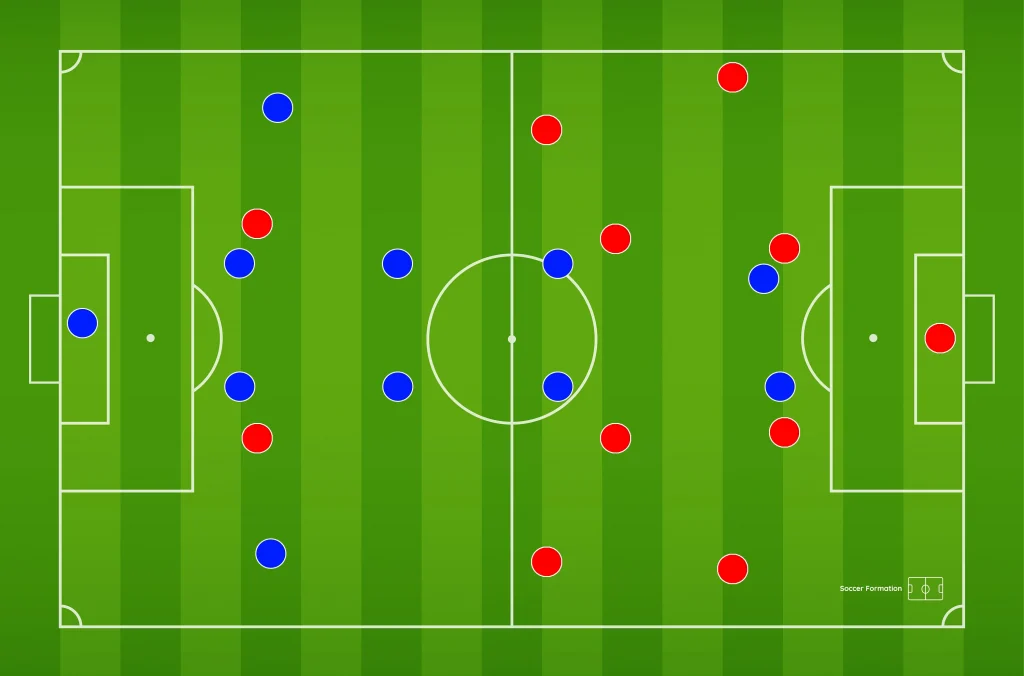
The 4-2-2-2 formation is characterized by a backline of four defenders, two holding midfielders, two attacking midfielders, and two strikers. This formation allows for a strong defensive presence while also providing plenty of options for attacking play. The two attacking midfielders can operate in the space between the opposition’s midfield and defense, creating chances for the two strikers to score goals.

The 4-2-2-2 formation is a variation of the 4-4-2 formation. The formation is structured with four defenders, two central midfielders, two attacking midfielders, and two strikers. The four defenders consist of two center-backs and two full-backs, with the full-backs providing width in attack. The two central midfielders sit in front of the defense and are responsible for distributing the ball and breaking up opposition attacks. The two attacking midfielders are positioned behind the strikers and are responsible for creating chances and scoring goals.
The two strikers in the formation are positioned close together, allowing them to play off each other and create chances. The formation is designed to provide balance between attack and defense, with the two banks of four providing a solid defensive foundation while the attacking midfielders and strikers offer a potent attacking threat.
Using the 4-2-2-2 formation effectively requires understanding the roles of each player, implementing appropriate tactics, and emphasizing teamwork and communication. Here’s a breakdown of how to use the formation:
Defenders
- Two center-backs: They should be strong, good in the air, and capable of winning tackles and headers. They must communicate effectively with each other and the fullbacks to maintain a solid defensive line
- Two fullbacks: They need to be quick, defensively sound, and able to contribute offensively. They should provide width by overlapping with the attacking midfielders and delivering crosses into the box.
Defensive midfielders
- Ball-winning midfielder: This player should be aggressive, possess excellent tackling skills, and have a high work rate. Their primary role is to break up the opposition’s attacks and protect the backline
- Deep-lying playmaker: This player should have good vision, passing ability, and positional awareness. They are responsible for distributing the ball to the attacking midfielders and forwards, as well as helping the ball-winning midfielder in defensive duties.
Attacking midfielders
- Wide attacking midfielders: These players should have good dribbling skills, pace, and creativity. They can either play wide to stretch the opposition’s defense or cut inside to support the forwards and create scoring chances. They should also track back to help the fullbacks defensively when necessary
- Central attacking midfielders: These players should possess excellent vision, passing, and decision-making skills. Their role is to create goal-scoring opportunities for the forwards and contribute to the attack by making runs into the box.
Forwards
- Target forward: This player should be strong, good in the air, and possess solid hold-up play skills. They can act as a focal point for the attack, holding up the ball and bringing others into play
- Support forward: This player should be quick, agile, and have excellent off-the-ball movement. Their role is to make runs behind the opposition’s defense, link up with the target forward, and score goals.
4-2-2-2 Formation Strengths
The 4-2-2-2 formation is a versatile and balanced formation in soccer that features four defenders, two defensive midfielders, two attacking midfielders, and two forwards. Some of the key strengths of this formation include:
- Solid defensive structure: The four defenders and two defensive midfielders provide a strong foundation, making it difficult for the opposition to penetrate and create goal-scoring opportunities
- Central control: With two defensive midfielders and two attacking midfielders, this formation allows for excellent control and possession in the central areas of the field. This can help dominate the midfield and dictate the tempo of the game
- Flexibility: The 4-2-2-2 formation can easily transition into other formations, like a 4-4-2, 4-3-3, or 4-2-3-1, depending on the in-game situation. This adaptability can make it harder for the opposition to predict and counter your tactics
- Attacking options: The two forwards and two attacking midfielders provide multiple attacking options, allowing for varied and unpredictable offensive play. This can include utilizing the width of the field with wide attacking midfielders or focusing on central play with more narrowly positioned attackers
- Quick transitions: With a compact central structure, the 4-2-2-2 formation is well-suited for quick transitions from defense to attack. The two defensive midfielders can win the ball and distribute it quickly to the attacking midfielders or forwards, launching rapid counterattacks
- Pressing: This formation is conducive to implementing a high-pressing style, with the attacking midfielders and forwards working together to pressure the opposition’s defense. This can force errors and create goal-scoring opportunities.
Of course, the effectiveness of the 4-2-2-2 formation depends on the players’ skills, understanding of their roles, and overall team chemistry. While there are clear strengths, it is important to consider the specific needs of your team and opposition when selecting a formation.
4-2-2-2 Formation Weaknesses
While the 4-2-2-2 formation offers several strengths, it also has some weaknesses that opponents may try to exploit:
- Vulnerability on the flanks: With a heavy emphasis on central control, this formation can leave the flanks exposed. Quick and skillful wingers from the opposing team can exploit the open space on the wings, putting pressure on your fullbacks and forcing your central midfielders to cover more ground.
- Overreliance on fullbacks: The fullbacks in the 4-2-2-2 formation are responsible for providing width and supporting the attack. This can lead to an overreliance on them, which can become problematic if they are not able to effectively contribute offensively or are caught out of position defensively.
- Isolation of forwards: If the attacking midfielders do not sufficiently support the forwards, they may become isolated and struggle to receive the ball or create scoring chances. This issue can be exacerbated if the opposition effectively cuts off passing lanes to the forwards.
- Demanding roles for defensive midfielders: The two defensive midfielders shoulder a lot of responsibility in this formation, as they must break up the opposition’s attacks, cover the flanks when needed, and initiate offensive transitions. If they are not up to the task or lack chemistry, the team’s overall performance may suffer.
- Difficulty against teams with strong midfields: The 4-2-2-2 formation can struggle against teams with strong midfields, especially those employing a three-man midfield. In such cases, the opposition can outnumber and outplay your midfield, making it difficult to maintain possession and control the game.
- Lack of natural wingers: Since the formation does not include natural wingers, it may not be well-suited for teams with players who excel in wide positions. Additionally, not having natural wingers can limit your team’s ability to stretch the opposition’s defense, which could make your attack more predictable.
To mitigate these weaknesses, coaches must adapt their tactics based on the specific needs of their team and the opposition. This may involve adjusting player positioning, modifying roles and responsibilities, or even changing formations during the game if necessary.
Teams That Use the 4-2-2-2 Formation
While the 4-2-2-2 formation is not as commonly used as some other formations like 4-3-3 or 4-4-2, it has been employed by various teams across different leagues and competitions, including:
- Paris Saint-Germain (PSG): Under head coach Thomas Tuchel (2018-2020), PSG occasionally utilized the 4-2-2-2 formation, with Neymar and Angel Di Maria playing as attacking midfielders behind the forwards, Kylian Mbappe and Edinson Cavani
- RB Leipzig: Under Julian Nagelsmann (2019-2021), RB Leipzig often employed a 4-2-2-2 formation, which helped them achieve impressive results both domestically and in the UEFA Champions League
- Manchester City: Pep Guardiola, known for his tactical flexibility, has occasionally used the 4-2-2-2 formation at Manchester City. This approach has allowed him to field multiple creative players, like Kevin De Bruyne and David Silva, in more central positions
- Brazil National Team: The Brazil national team has used the 4-2-2-2 formation in the past, particularly during the 1990s and early 2000s, when they had an abundance of attacking talent, including Ronaldo, Rivaldo, and Ronaldinho
- Bayer Leverkusen: Under head coach Roger Schmidt (2014-2017), Bayer Leverkusen employed a high-pressing 4-2-2-2 formation, which saw them achieve considerable success in the German Bundesliga.
These examples demonstrate that the 4-2-2-2 formation can be effective when executed correctly, particularly when a team possesses the right balance of attacking and defensive talent. However, it’s important to note that tactics and formations are constantly evolving in the world of football, and the popularity of specific formations may vary over time.
4-2-2-2 Versus Other Formations
Let’s see how the formation matches up against other popular formations:
4-2-2-2 Versus 4-4-2
4-2-2-2 Versus 4-3-3

4-2-2-2 Versus 4-2-3-1

4-2-2-2 Versus 3-5-2

4-2-2-2 Versus 3-4-3

Conclusion
While the 4-2-2-2 formation has many advantages, it also requires a high level of tactical awareness and discipline from the players. The two holding midfielders must be able to cover the defense when needed, while also providing support to the attacking players. The attacking midfielders must be able to create chances for the strikers, while also tracking back to help defend.
Overall, the 4-2-2-2 formation is a popular choice for teams looking to strike a balance between defense and attack.
FAQs
Here are some FAQs related to the 4-2-2-2 soccer formation:
The 4-2-2-2 formation can be a good formation when used effectively, as it offers a balanced and versatile approach to both attack and defense. Its strengths include a solid defensive structure, central control, flexibility, and a variety of attacking options. Additionally, it allows for quick transitions and can be conducive to implementing a high-pressing style.
However, the effectiveness of the 4-2-2-2 formation depends on several factors, including the quality and characteristics of your players, their understanding of their roles within the formation, and the tactics employed by the coach. It’s also essential to consider the opposition’s strengths and weaknesses when determining if the 4-2-2-2 formation is the best option for a particular match.
Like any formation, the 4-2-2-2 has its weaknesses, such as vulnerability on the flanks and potential isolation of forwards. It’s crucial for coaches to adapt their tactics and make necessary adjustments to address these weaknesses and maximize the formation’s effectiveness.
Ultimately, whether the 4-2-2-2 formation is “good” depends on how well it suits your team’s style of play, the players’ skill sets, and the specific demands of the match. It’s important for coaches and teams to be flexible and willing to adjust their formation and tactics as needed to achieve the best results.
Communication and teamwork are crucial for the 4-2-2-2 formation to function effectively. Make sure players understand their roles and responsibilities and adapt tactics as needed to counter the opposition’s strengths and exploit their weaknesses. Some ways the 4-2-2-2 formation can be used include:
– Encourage quick transitions from defense to attack by distributing the ball swiftly to the attacking midfielders or forwards
– Implement a high-pressing style to force errors and win possession higher up the pitch
– Focus on maintaining possession and controlling the central areas of the field
– Exploit the opposition’s flanks by using overlapping fullbacks and wide-attacking midfielders.